This précis of Mary Jo Hatch's "Dynamics of Organizational Culture" synthesizes ideas from evolutionary sociology and anthropology to explain how stability and change simultaneously exist in organizational culture. The purpose of this approach is to “build support for a theory of cultural dynamics that considers stability and change as dual products of the same cultural processes” (Hatch, 2004, 191).
Introduction
Change and stability simultaneously exist in organizations. Writers from sociology and anthropology have documented both stability and change in cultures, noting the evolution and dynamics of culture. However, writers of organizational literature have focused chiefly on culture as a stable force that resists change, moving only through management intervention. Most of the literature emphasizes the benefits of changing organizational culture to enhance performance by pitting stability against managerial demands for adaptability.
Writers who do not adopt this view are interpretants who focus on meaning, sense-making, and symbolism but overlook the dynamic properties of culture. Interpretants do not focus specifically on change, but those with a critical perspective emphasize resistance to resist change and fight for power. The competing managerial and critical perspectives assume that cultural stability is the root of resistance.
From the critical perspective worker solidarity can resist management oppressors. From the managerial perspective, cultural hangovers constrict day-to-day processes. Marin and Frost (1996 in Hatch, 2004) called this clash the “organizational culture war games” (191). The battle lines in this war emphasize consistency, harmony, and consensus, with the perspective that culture consists of subcultures with competing epistemological positions.
Organizational literature traditionally attempts to resolve the conflict by asserting that fitting employees with organizational values can create cultural harmony. The war games metaphor draws attention to debates within culture but distracts from the cultural dynamics at work within a culture.
This chapter will apply ideas from evolutionary sociology and anthropology to explain how stability and change simultaneously exist in organizational culture. The purpose of this approach is to “build support for a theory of cultural dynamics that considers stability and change as dual products of the same cultural processes” (Hatch, 2004, 191).
Cultural dynamics in evolutionary sociology and cultural anthropology
In the 1880s, Lester Ward proposed that evolutionary mechanisms evolve. Evolutionary anthropologists applied this concept to cultural evolution. For example, Sahlins and Service (1960 in Hatch, 2004) saw general evolution as the types of cultures that emerge through the general direction of humanity and specific evolution as the adaptations that occur in response to particular environments.
Cultural anthropologists typically denied evolution but reached a similar conclusion: understanding concrete cultural change requires defining its underlying processes. With a focus on cultural change, early anthropologists of cultural dynamics understood the importance of considering change with stability while noting that different cultures move at different rates. This suggests two important keys for unlocking organizational dynamics.
- Just as change is a constant force in humanity, change is also constant in organizational cultures.
- Just as different parts of human culture change at different rates, parts of organizational culture change while other parts remain stable; stability and change simultaneously exist in organizational culture.
Linton (1936 in Hatch, 2004) described how a culture contains similarities and differences. Universals of culture are the behaviors shared across the culture. Specialties of culture explain the behaviors of a specialized group. Alternatives of culture demonstrate behaviors that society accepts as valid, but that cut across diversity classification. Individual peculiarities are experimental forms of behavior, which serve as sources of cultural innovation. Linton argued that cultural elements have four interrelated qualities that can vary as cultural elements change: form, meaning, use, and function. These cultural elements dynamically interact with cultural specialties, peculiarities, and alternatives to innovate cultural change.
Herskovits (1948 in Hatch, 2004) identified two types of change: change from within and change from the outside. Anthropology finds more evidence supporting change from the outside but asserts that change seems to generalize to change from within. For example, in studying the introduction of European culture into Africa, Malinouski (1945 in Hatch, 2004) argued that change among institutions was mutual, with each culture satisfying needs in different ways with different techniques using the same resources. This exchange process is essential for organizational researchers because it explains how cultural change is not simply the consequence of adding or mixing two cultures but a complex reaction that creates autonomous change leading to new cultural realities.
Malinouski (1945 in Hatch, 2004) recognized stability as a counterforce to change, noting that established cultural elements acted as stabilizing forces that limited the emergence of the new system. This limitation causes three possible products of contact between cultures: conflict, cooperation, or compromise. Cultural change through planned incursions becomes domination of one group by another. In this case, resistance emerges in the struggle for domination among the groups. This means that resistance is not in the culture but that the domination in cross-cultural relationships is accountable for resistance.
Applied to organizational change, this cross-cultural perspective helps differentiate followers and leaders as belonging to different cultures, explaining the powerful resistance that can occur when management implements change interventions. Understanding the power relations suggests that a better approach to cultural change is to acknowledge and participate in the dynamic processes that already exist in the culture, thus fitting the intervention into the flow of change and stability inherent in the culture. This requires a simultaneous focus on what to preserve and change, innovating cultural change by introducing new meaning through dynamic interaction.
Processes of cultural change and stability
An important limitation of applying anthropology in organizational research is that contemporary society is not tribal. However, even though contemporary organizational researchers ignore anthropology, they describe similar processes as those described by anthropologists. This section will identify some of the processes of change and stability identified by anthropologists and compare them to contemporary organizational culture studies.
Evolutionary patterns: Variation, growth, decline
Early theories of cultural change assumed that cultural variation was universal. In the variation process, introducing alternatives drives change. Alternatives often exist in a culture. For cultural change to occur, an aggregate number of individuals negotiate a consensus on cultural behavior, creating a dynamic reaction through which cultural deviations become standardized through consensus. Through this process of cultural growth and decline, new patterns of behavior become stable through institutionalization, pushing out old patterns and institutions.
This perspective is dated. However, it proposes an essential consideration of the institution’s role in cultural dynamics. Institutions are “static remains of once dynamic cultural patterns,” making them “cultural fossils” that provide clues about the consciousness and meaning of the past (Hatch, 2004, 198). Kroeber argues that institutions prevent new learning. In comparison, institutional theory sees institutions as explanations of static culture. While institutionalists see the institution as a means of maintaining and transferring knowledge, Kroeber (1944 in Hatch, 2004) argues that institutions are artifacts that inhibit understanding and meaning. This perspective is contentious but suggests a distinction between cultural meaning and institutions. Sevon (1966 in Hatch, 2004) attempts to resolve the tension between institutional theory and cultural change by introducing variation, arguing that no original ideas exist, but innovation occurs as cultures imitate old ideas through different perspectives. Roach (1995 in Hatch, 2004) calls this “repetition with a difference” (46), a process that creates conditions for stability and change to interact simultaneously. While institutions stabilize behaviors, they accommodate change.
Change from outside: Diffusion, acculturation, and selective borrowing
Anthropologists recognized that groups close to others tend to share more cultural traits than groups that are distant. Anthropologists use diffusion and acculturation to describe the processes that underlie cultural borrowing. Diffusion considers the cultural transmission that has occurred; acculturation considers cultural transmission as it is happening. Borrowing from other cultures is universal and usually occurs when a dominant group is influenced by the cultures’ customs. Acculturation research shows that borrowing is a selective process; people borrow practices that seem worthwhile and discard those that seem impractical. Herskovits (1964 in Hatch, 2004) argued that cultural contact “is never a process of addition” (177). Instead, borrowing is a process that focuses on and reinterprets the rewarding aspects of a different culture, merging them with the existing culture to create something new. Thus, cultures change through a negotiation process of conflict and compromise to build divergent meanings and behaviors.
Considering focus as a mechanism of cultural change applies to organizational change by helping leaders understand that their cultures may intensify focus inside the organization to facilitate culture change processes. Isolated leaders will be less effective change agents because they will not understand the focus of the organizational members. Another vital point to consider is reinterpretation, meaning how the culture assimilates new ideas into existing cultural patterns to minimize disruption. Reinterpretation involves applying old meaning to new forms or giving new meaning to old forms. Re-contextualization is a similar concept that explains how cultures provide new meanings to borrowed artifacts to minimize disruptions to the existing cultural patterns.
Change from within: Enculturation, re-enculturation, and cultural innovation
Enculturation explains how cultures remain stable and how cultures transfer symbols, practices, and meanings from one generation to another. Enculturation involves conditioning to fundamentals and absorbing ethics, aesthetics, and group conventions in human development. As humans reach maturity, they have sufficient conditioning to move quickly within the limits of cultural boundaries [people never grow up, they just learn how to behave] and can make decisions about new forms of behavior presented by cultural change. Herskovits (1964 in Hatch, 2004) argues that early enculturation leads to stability but can lead to cultural change in maturity as adults.
Adults can learn, relearn, and unlearn culture by reconditioning responses to new stimuli and re-enculturating themselves. This later enculturation is a conscious process that creates an opportunity to change by examining alternatives for new ways of thinking and behaving.
Organizational theorists call this concept socialization, meaning how new members of an organization make sense of the environment and learn its culture to adapt to its values, norms, and practices. This adaptation can be mutual. Just as anthropologists recognize that individual peculiarities can be the source of cultural innovation, socialization can be a process by which individuals influence change while maintaining stability. Cultural innovation through socialization occurs partly because different people react differently to the same situation, which can induce change (Barnett, 1953 in Hatch, 2004).
Cultural dynamics in organizational studies
Three theories of organizational culture imply that stability and change exist simultaneously in organizational cultures, Shein’s three-level model of culture, Gagliardi’s typology of culture change, and Hatch’s cultural dynamics described below:
Schein’s theory of organizational culture and leadership
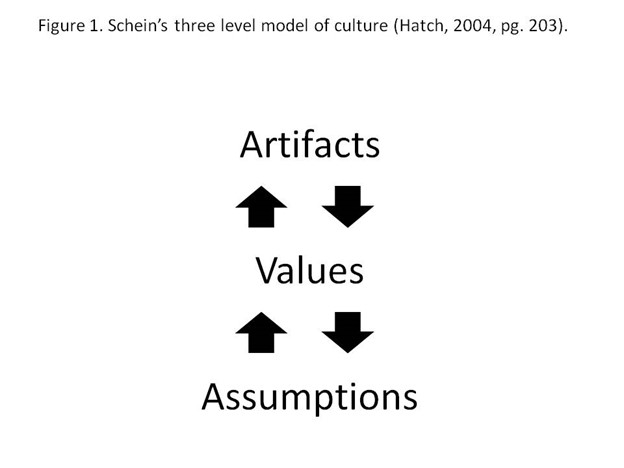
Shein (1985/1992 in Hatch, 2004) borrowed ideas directly from anthropology to propose organizational change and leadership theory that portrays culture on three levels: artifacts, values, and assumptions [Figure 1].
- Artifacts are the visible, tangible, and audible features on the surface of the culture, which are driven by the underlying values and assumptions.
- Values and assumptions lie beneath the surface of the culture. Values are the social principles shared by the culture.
- Assumptions are the deepest part of the culture because they draw from the subconscious mind conditioned by the former experiences and socialization of the members of the culture. In other words, the assumptions are the beliefs that the members take for granted. Understanding assumptions is the key to understanding and changing culture.
Schein’s model proves unworkable because it depends on making connections between assumptions, values, and artifacts while leaving critical gaps that dismiss an appreciation of culture as symbols and processes shared in organizational life.
Gagliardi’s three types of cultural change
Focusing on the relationship between strategy and culture, Gagliardi (1986 in Hatch, 2004) built on Shein’s Assumptions > Values > Artifacts model to propose a theory that shows stability and change as opposing forces with three outcomes: apparent change, incremental change, and revolutionary change.
Apparent change
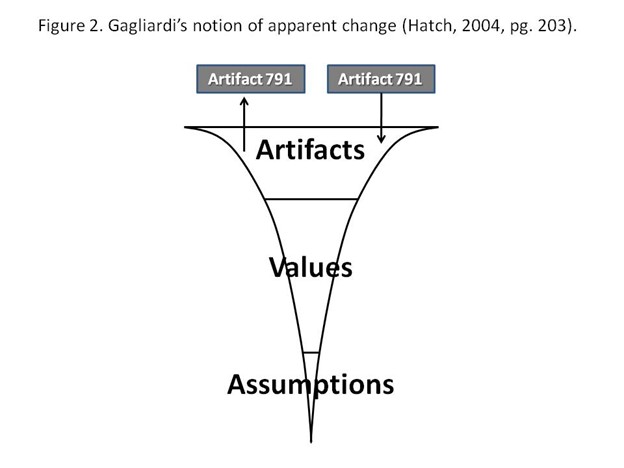
Apparent change [Figure 2] happens inside a culture but does not change the fundamental nature of the culture. Apparent change is an example of how cultures change while staying the same, like when interventions realign activities around the existing assumptions and values, changing only the cultural artifacts.
Incremental change
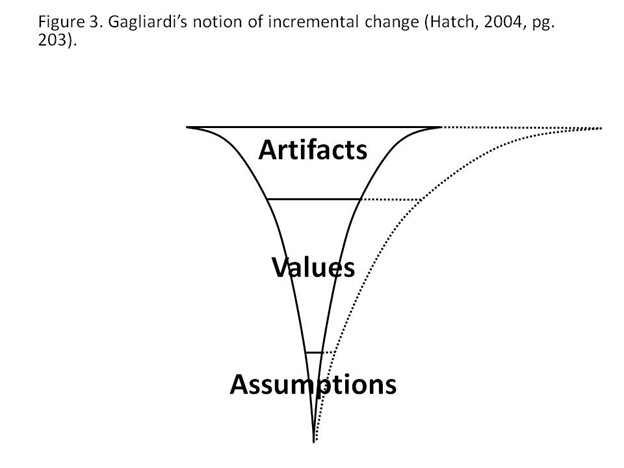
Incremental change [Figure 3] introduces new compatible values that exist with the old values. Implementing different strategies that remain compatible with existing assumptions and values can expand the culture.
This concept is similar to Koreber’s (1944 in Hatch, 2004) cultural growth concept in that the existing cultural patterns reinforce the growing patterns, allowing them to cumulatively develop. This suggests that successful incremental strategies require a process that resonates with the web of cultural meaning rather than just understanding the compatibility of assumptions and values.
Revolutionary change
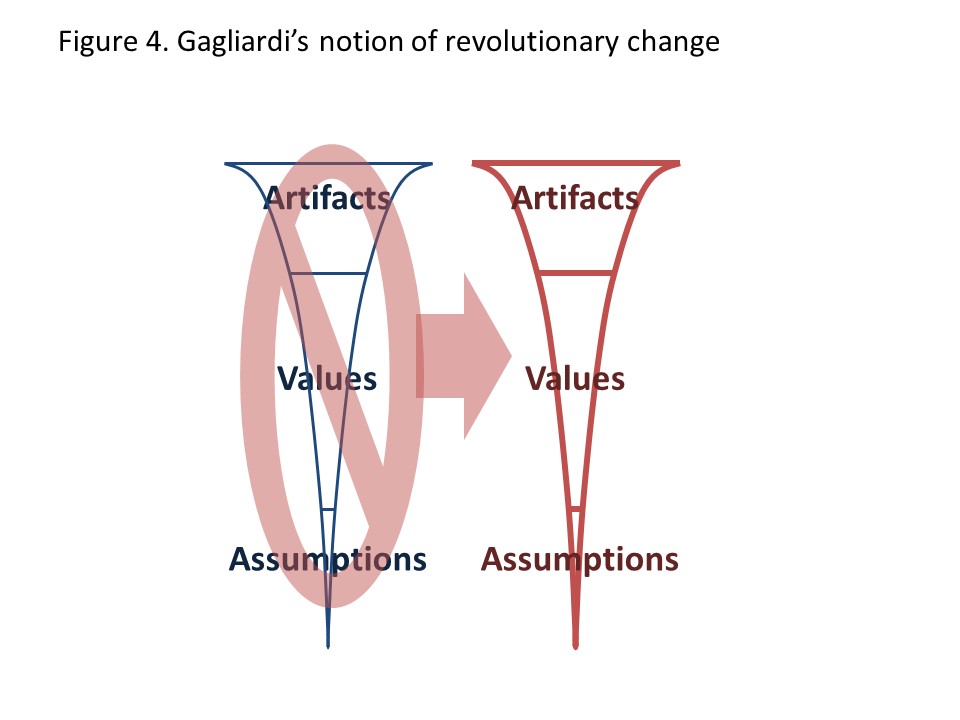
Revolutionary change [Figure 4] imposes a strategy that is incompatible with key assumptions and values using outsiders who destroy old symbols while they create new ones. Examples include bringing in a new chief executive officer from outside the organization, merging two organizations, and downsizing an organization. Strategies that conflict with assumptions and values destroy the existing culture or resist. More accurately, the old firm dies, and a new firm is born. Culture is replaced, not changed. Kroeber had proposed a similar model through which he viewed revolt against cultural patterns, a concept he called pattern rupture.
Arguing that concepts like harmony and symmetry can become mechanical and dull, Kroeberg (1944 in Hatch, 2004) proposed that revolt “is not necessarily the worst course” (765). Innovation comes from breaking patterns, not from preserving them. This may glorify revolution, but it does provide a point for organizational writers to consider. Outdated operational modes can threaten the viability of organizations, like when Western economies exhausted domestic manufacturing as an economic pattern. In such cases, economic viability may justify the destruction of cultures built on outdated patterns. Recent experiences confirm that cultural renewal can follow cultural destruction.
Hatch’s dynamics of organizational culture
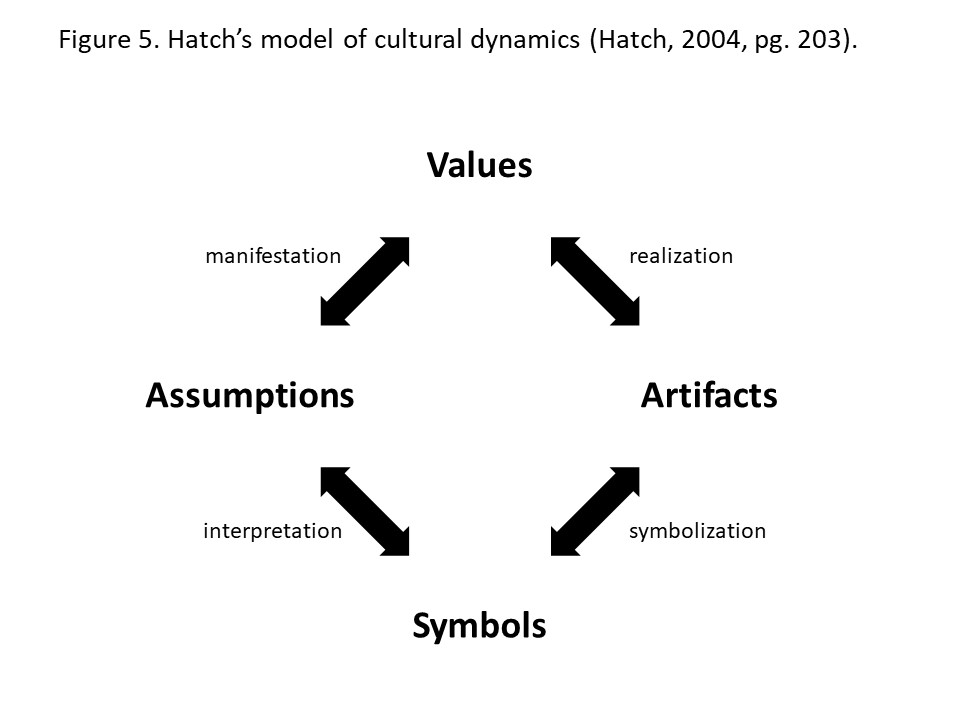
Hatch (2004) proposed a dynamic circular pattern in culture in which the individual and group mutually interact in existing cultural patterns while creating cultural patterns [See Figure 5]. Following Herskovits’s (1948, in Hatch 2004) circular notion about cultural processes supporting stability and change, Hatch reformulates Shein’s Assumptions > Values > Artifacts organizational culture framework by redrawing the model from a symbolic-interpretive perspective and introducing dynamism into organizational culture theory.
Considering the relationship among cultural elements, Hatch’s cultural dynamics model proposes that culture consists of four interrelated and dynamic processes: manifestation, realization, symbolization, and interpretation. The reformulated model places assumptions, values, artifacts, and symbols in a wheeled framework, showing the relationships between the elements and the processes, as follows:
Manifestation processes
Manifestation is how essence reveals itself, usually through the senses, cognition, or emotion. In the cultural dynamics model, assumptions appear in members’ perceptions, thoughts, and emotions.
Realization processes
Realization is the process by which something becomes real. In the cultural dynamics model realization processes are proactive and reactive.
Symbolizing processes
A symbol represents a conscious or unconscious association with a broader meaning. Logos, slogans, stories, actions, and metaphors serve as common symbols in an organization.
Interpretation processes
Interpretation is the process by which members apply meaning to an experience. The cultural dynamics framework puts symbolization experiences in context by giving members a reference for constructing meaning.
Integrative processes
Integrating the model with the cultural focus concept provides a better understanding of management’s role in cultural dynamics by helping managers intensify efforts on the areas of focus that are readily changeable. The processes in the cultural dynamics model are constant, so changes should begin at the stage that best represents the depth of change. Placing the manager within the organizational culture suggests that the power of leadership lies in their sensitivity to the symbolic meaning of being a leader. A leader’s ability to influence a culture depends on their “knowledge of and relationship with the culture” (207).
Regardless of what a leader does and how a leader intervenes, culture is a dynamic process in which stability and change are in constant motion. In addition, a dynamic model of cultural change suggests that stability and change cannot be predicted. They can only be interpreted and explained after the fact.
Conclusion
The dynamic theories presented by Schein, Gagliardi, and Hatch represent a progression of thinking that shifts management from the center of culture to seeing management as part of a dynamic cultural process. Hatch’s model adds circularity among the relationships and processes. This provides a return principle that exists neither in Shien’s top-down hierarchy nor in Gagliardi’s model of unidirectional change over time. The models show “growing sensitivity to the symbolic-interpretive aspects of culture” (207). The models also show connections between contemporary organizational theory and the cultural dynamics theories expressed by cultural anthropology and evolutionary sociologists.
Organizational culture researchers have replicated and extended the process of cultural stability and change described by cultural anthropologists and evolutionary sociologists. This might invite accusations of revisionist history, but anthropology and sociology provided rich commentary on a culture that is missing from traditional organizational studies writings. Organizational and sociological thought inspired theorizing about culture in organizational settings. The connections between anthropology and sociology and contemporary organizational culture theory support connections among them, while organizations provide a rich context for exploring dynamic cultural processes.
References
Hatch, M. J. (2004). Dynamics in organizational culture. In M. S. Poole, & A. H. Van de Ven, Handbook of organizational change and innovation (pp. 190-211). New York, NY: Oxford University Press.