Group decisions illuminate individual psychology and group existence by explaining how groups influence individual motivation and change. A fundamental question of action research is how to prevent groups from reverting to prior behaviors after a change intervention. Social processes show that group decisions lead to lasting social change. The effectiveness of group decisions depends on the process and the group position within the social context. A group decision is “a process of social management related to social channels, gates, and gatekeepers; the problem of perception and planning; the relationship between motivation and action; and the relationship between individual and group” (263).
Channels, gates, and gatekeepers
Research conducted on food habits in a Midwestern town found that food comes to the table through different channels, also called gates. The food buyer for a family serves as a gatekeeper who makes decisions about what appears on the table. Changing the food habits of a family depends on changing the psychology of the gatekeeper. Ideology strongly influences the gatekeeper. Preferences of family members influence food habits only to the degree that they influence the gatekeeper.
Planning, fact-finding, execution
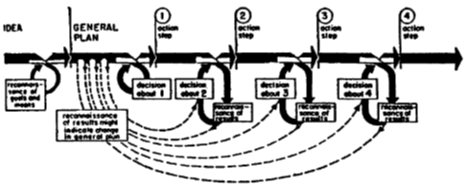
Planning starts with an idea and a desire to reach an objective, then cycles toward the objective in a spiral of steps, including planning, execution, and fact-finding. The planning step includes clarifying the path to the objective starts with examining the idea and considering available resources to generate a plan that consists of the steps for reaching the objective. The next phase is to execute the plan while conducting fact-finding to evaluate actions, adjust before the next step, modify the plan, and learn. Most areas of social management lack objective achievement standards because social managers lack the reconnaissance or fact-finding to determine satisfaction or allow learning.
Social channels, social perception, and decision
The theory of channels and gatekeepers provides a framework for understanding how objective distribution problems intersect with subjective cultural problems and focuses on the social channels influencing attitudes and decisions. The relationship between group decision and individual action is:
- Group decisions depend on group perceptions, and;
- Correct perception is necessary for determining subsequent steps. Since objective evaluation is a prerequisite for facilitating social change, social managers must measure the effectiveness of group decisions.
Group decisions versus lecture
Degree of involvement
Researchers tested the effectiveness of high-pressure sales lectures versus group decisions for increasing homemaker use of intestinal meats in the home in an experiment in changing food habits. In follow-up surveys, three percent of the women who had heard the lectures served meats they had never served before. In comparison, 32% of the women who participated in the group decision process served meat they had not served before.
An audience in a lecture passively participates, while group decisions actively engage members in a process without restricting decision freedom. The high-pressure sales tactics and passive participation in a lecture environment increase resistance, while group decisions minimize resistance.
Motivation and decision
A decision means that one alternative has become dominant enough to influence action. A lecture may influence the motivation of a listener, but it rarely leads to a decision that causes the user to take action. In other words, “a lecture is not often conducive to a decision” (273). Similarly, group discussions can contribute to higher involvement but do not lead to a decision. This is a crucial point to consider, discussions and lectures are different, but their influence on actions is not. However, a group decision that follows a group discussion plays a vital role in influencing action.
Individual versus group
Attempting to change individual behaviors through mass or individual approaches psychologically isolate individuals with their own ideas. Research has shown that changing the ideology and behavior of individuals is more accessible in small group environments than with individual focus because individuals tend to be unwilling to go against group standards. This helps explain why group decisions are more effective than lectures. Though the lecture takes place in a room filled with people, lack of interaction means that a lecture isolates the individual with their own thoughts. Contrarily, the group discussion and decision expose the individual to other ideas and social pressures that influence individual decisions about individual goals in a group setting.
Limitations
Expectations and leader personality may have also influenced the results of the experiment. In the group decision, the leader informed the members that he would follow up to ask if they introduced a new food into the family diet; the lecturers did not make a similar announcement. The lecture team was credible and experienced regarding leader personality, but the group leader was a facilitator with “unusual ability” (274). Regardless of these limitations, similar research studies confirmed that group decisions are considerably more effective at influencing individual actions than are lectures. Subsequent research and follow-up surveys also showed that behavior changes influenced through the group process remained more constant than behavior changes influenced by the lecture.
Quasi-stationary social equilibria and the problem of permanent change
Social change is a process, not a thing. Planned social change must consider situational factors to determine the appropriate mix of educational and organizational actions for intervention.
Understanding the conditions for change starts with analyzing equilibrium. Important to realize that the status quo of social conditions is not a static state but a “quasi-stationary equilibrium” (279). As a river flows in a specific direction with a certain velocity over time, social change flows at different speeds in a given time. An equilibrium social state means that the forces for change balance against the forces for no change. However, social forces always vary. The forces for raising standards grow against those for lowering standards, creating a central force field that maintains equilibrium. Changing the strength of positive forces without changing the level of opposing forces drives change toward the positive.
In social management, changing the social status quo involves increasing forces in the desired direction or decreasing opposing forces. Strengthening forces for change increases the tension that can cause resistant reactions, as in the high-pressure lecture approach to influencing change in consumption behaviors. The group decision process avoids pressure techniques and is sensitive to resistance. The success and permanency of group decisions could be due to minimizing opposing forces within the individual rather than by applying outside pressure.
Social habits and group standards
Understanding the status quo as the result of a quasi-stationary equilibrium helps illuminate how increasing force changes the process level. “Social habit” (281) implies social process will not change due to intrinsic resistance that is strengthened by habit. Reducing resistance requires applying force sufficient to break the habit, a process called “unfreeze” the custom (281). Social patterns tend to be anchored in the relationship between the individual and the social group. If individual behavior deviates from the accepted group behavior, the individual faces social pressures to comply with group standards, as long as the individual values membership in the group. If individual resistance is due to the member’s group membership, reducing individual resistance would mean diminishing the value of the group for the individual. Contrary to expectations that face-to-face encounters might be more effective at changing individuals, research shows that individual behavior is easier to change when individuals are formed into groups than separated from groups.
Change as a three-level procedure: Unfreezing, Moving, Refreezing
Changes toward a higher level of performance are usually short-lived. Groups generally return to previous levels after a short performance increase. This shows that setting objectives and creating plans are not sufficient for permanently maintaining change. A successful and permanent change requires unfreezing, moving to a new level, and freezing at the new level. A force field determines each level, so permanency implies that a new force field secures the level against reversion. Unfreezing can involve a catharsis that breaks complacency and deliberately stirs emotions. The procedure is easy to execute, social managers should develop skills to diagnose and influence the situation. Group decision facilitates change because individuals tend to act more readily as group members than they are to act on personal preference.
Reference
Lewin, K. (1948). Group decision and social change. In T. M. Newcomb, & E. L. Hartley, Readings in social psychology (pp. 330-341). New York, NY: Henry Holt.