

- Details
- Written by Brent A Duncan, PhD
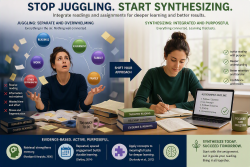
A common challenge I hear from students turning in late assignments is this:
“I can’t start working on the project until I’ve completed all the readings.”
Many of us have felt the same way, especially when attempting "juggle" work, family, and coursework. The good news is that there is a more effective approach to learning, performance, and deadlines. In short: Stop juggling and start synthesizing.
- Details
- Written by Brent A Duncan, PhD
![Polished slides. Unreadable message. When presentation design ignores the audience, even the most “impressive” deck fails in the room. [Image: Copilot]](/images/AI-Presentation250.png "Polished slides. Unreadable message. When presentation design ignores the audience, even the most “impressive” deck fails in the room. [Image: Copilot]")
That moment of “look what I did” after generating a presentation with AI is real. The slides look polished, structured, and content-rich. It feels fast, efficient—even impressive.
But that reaction usually belongs to the presenter, not the audience. To them, the signals are different—and often immediate. The slides feel generic, overbuilt, and oddly disconnected. It’s clear they weren’t thoughtfully designed—they were assembled by a robot.
- Details
- Written by Brent A Duncan, PhD
Summary: Wikipedia is an unreliable source for academic and professional research. This article examines how political influence, corporate reputation management, and paid editing expose the limits of open knowledge and offers clear guidance on using primary sources, premium databases, and independent verification to protect research credibility.
- Details
- Written by Brent A Duncan, PhD
Summary: Convenience should not be mistaken for credibility in academic or professional work. While Wikipedia and other encyclopedias can help readers get oriented, they are not appropriate sources to cite. Wikipedia itself acknowledges it is not a reliable academic source. This is because the content is user‑edited rather than expert‑driven, authorship and accountability are unclear, and articles can reflect bias, oversimplification, or unresolved disputes. As a tertiary source, Wikipedia summarizes others’ work instead of presenting original, peer‑reviewed analysis. Its open‑edit model also creates structural risk for agenda‑driven editing despite formal policies. Use Wikipedia only as a pointer to original sources, then consult premium university databases. Don't risk credibility just because Wikipedia is easy. Show pride in original work and rigor.
- Details
- Written by Brent A Duncan, PhD
![A polished analysis built on public domain data is a house of cards. It may look impressive—until a single question exposes the weakness of the sources. Defensible, premium evidence provides the solid foundation that withstands scrutiny. [Image: Copilot]](/images/Images/public-domain-v-premium-data250.png "A polished analysis built on public domain data is a house of cards. It may look impressive—until a single question exposes the weakness of the sources. Defensible, premium evidence provides the solid foundation that withstands scrutiny. [Image: Copilot]")
Quality of Sources Matters: What Your Research Choices Say About Your Competence
By Dr. Brent Duncan, PhD
Summary: In professional settings, the quality of your analysis is inseparable from the quality of your sources. While public search engines and AI tools make information easy to access, most of what they surface is low‑quality noise unless carefully filtered. MBA‑level work requires disciplined source selection, critical evaluation, and effective use of premium research resources. How—and where—you research signals your judgment, credibility, and professional competence.