

Summary: Perceptual mapping is a powerful marketing tool that helps organizations visualize how customers perceive competing brands. Using General Motors as a case study, this article explores how brand overlap among Chevrolet, Pontiac, Oldsmobile, Buick, and Cadillac contributed to customer confusion and strategic challenges during the 1980s. By comparing historical and modern perceptual maps, the discussion highlights the importance of brand differentiation, portfolio management, competitive positioning, and the human value proposition. The article also examines how competitors such as Toyota, Honda, BMW, Mercedes-Benz, and Lexus established clearer customer perceptions and stronger market positions, creating lasting competitive advantages through meaningful brand identities.
Why do customers choose one brand over another when the products may be remarkably similar?
One tool marketers use to answer that question is perceptual mapping. A perceptual map is a visual representation of how customers perceive competing brands, products, or services relative to one another. Rather than focusing on technical specifications or internal company assumptions, perceptual maps help marketers see the marketplace through the customer's eyes.
The process is straightforward. Customers evaluate competing brands on attributes that influence their purchase decisions, such as price, luxury, quality, reliability, performance, convenience, or innovation. Those perceptions are then plotted on a map, allowing marketers to identify competitive clusters, gaps in the market, opportunities for differentiation, and areas where customers may be confused by overlapping offerings.
The real value of perceptual mapping is that it reveals how customers think. Companies often focus on how they intend to position their brands. Customers, however, respond to how they actually perceive those brands. When those perceptions are unclear, organizations risk creating confusion, diluting resources, and losing customers to competitors with clearer value propositions.
An Undergraduate Project That Stayed With Me
One of my favorite examples of perceptual mapping comes from a project I completed as an undergraduate student in the early 1980s.
The task was to analyze the General Motors brand portfolio for overlap and redundancy and determine whether the company should streamline its offerings.
At the time, GM's major consumer brands included Chevrolet, Pontiac, Oldsmobile, Buick, and Cadillac. My conclusion was that consumers were being asked to distinguish among several brands that often sold very similar vehicles. While each brand maintained its own identity, many of the products shared platforms, engines, features, and design elements.
Rather, than recommend strengthening brand differentiation, I proposed that GM should streamline its portfolio by retaining one of the middle-market brands and retiring the others. The company did not need three brands competing for essentially the same customer. Resources could be concentrated on building a stronger and more distinct brand rather than spreading investments across multiple overlapping offerings competing for the same customer in an increasingly crowded market.
Interestingly, it was not until more than twenty years later that GM reached a similar conclusion. Oldsmobile was retired in 2004 and Pontiac followed in 2010. While many factors contributed to those decisions, they highlight the difficulty of sustaining multiple brands that occupy similar positions in consumers' minds.
Whether my recommendation was right or wrong is less important than the lesson: organizations often focus on how they view their brands, while customers focus on how they perceive them.
GM's Brand Portfolio in the Early 1980s
Using Price and Luxury as the dimensions, GM's portfolio looked something like this in the early 1980s:
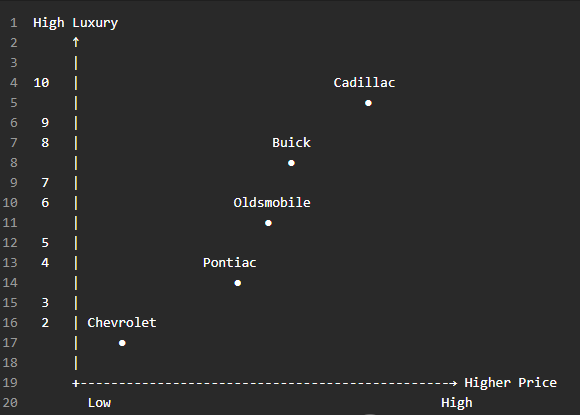
Perceptual map showing the positioning of General Motors brands in the early 1980s based on perceived price and luxury. The map highlights significant overlap among Pontiac, Oldsmobile, and Buick, illustrating why brand differentiation and portfolio simplification became strategic challenges for GM. (Image: Copilot)
What the Map Reveals
Cadillac clearly occupied the luxury position, while Chevrolet filled the value-oriented role.
The challenge appeared in the middle of the map, where Pontiac, Oldsmobile, and Buick clustered together competing for a similar customer. While marketers could explain the distinctions between these brands, those distinctions were not always obvious to consumers.
A perceptual map forces us to ask a simple question:
If customers cannot easily explain why one brand is different from another, does that differentiation really exist?
The Bigger Problem: Competing Against Yourself
The greatest risk of brand overlap is not merely internal competition. When multiple brands occupy similar positions in consumers' minds, customers may abandon the entire portfolio in favor of competitors with clearer and more compelling value propositions.
During the 1980s, foreign manufacturers were gaining momentum by establishing strong and distinct brand identities:
- Toyota became associated with reliability, quality, and efficiency.
- Honda developed a reputation for engineering excellence and practical innovation.
- BMW strengthened its position around performance and driving dynamics.
- Mercedes-Benz represented luxury, prestige, and engineering excellence.
- Volvo built a powerful association with safety.
While GM customers were often trying to understand the differences among Pontiac, Oldsmobile, and Buick, competitors were building clear positions in consumers' minds.
The question was not simply:
Why should I buy a Pontiac instead of a Buick or an Oldsmobile?
The more important question was:
Why should I buy any of them instead of a Toyota, Honda, BMW, Mercedes-Benz, or Volvo?
If the answer relies primarily on minor differences in trim packages, styling, or marketing slogans, the brands may not be creating enough value to compete effectively.
This is where perceptual mapping becomes especially powerful. It helps organizations understand not only how their brands relate to one another but also how they compare to the alternatives customers are considering.
GM's Brand Portfolio Today
Today's GM portfolio is much simpler.
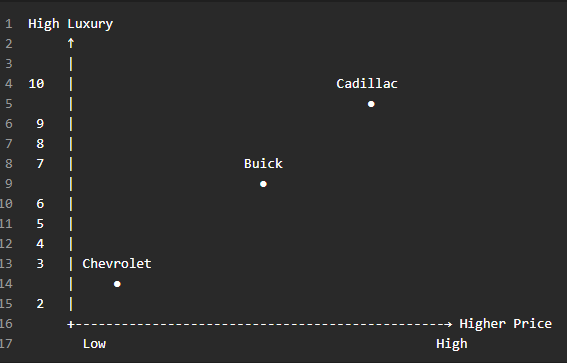
Perceptual map illustrating the current positioning of Chevrolet, Buick, and Cadillac based on perceived price and luxury. Compared to the 1980s portfolio, the modern GM brand structure demonstrates clearer market segmentation and stronger differentiation between value, premium, and luxury offerings. (Image: Copilot)
At first glance, this appears to be a cleaner portfolio with clearer market separation.
- Chevrolet = Value and accessibility
- Buick = Premium comfort and refinement
- Cadillac = Luxury, prestige, and innovation
The overlap that once existed among Pontiac, Oldsmobile, and Buick has largely disappeared.
A Different Map Tells a Different Story
One of the most important lessons of perceptual mapping is that the insights depend entirely on the dimensions selected.
Our first map examined Price and Luxury, which helped illustrate overlap within GM's portfolio. However, consumers do not make purchasing decisions based solely on luxury and price. Many also evaluate brands on quality, reliability, durability, and long-term value.
If we change the dimensions to Quality and Price and add key competitive brands to the mix, the landscape looks very different.
Today's Market: Quality vs. Price
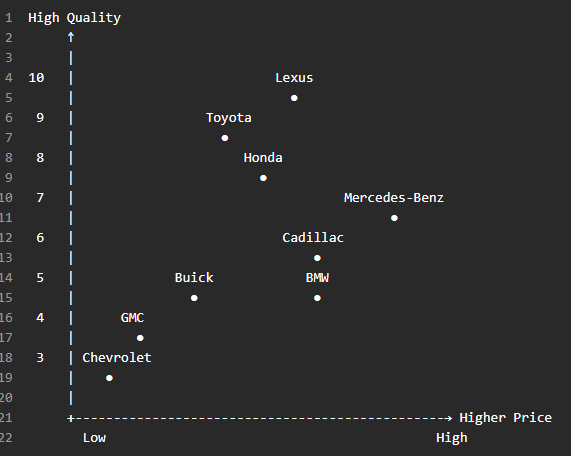
Perceptual map comparing major automotive brands based on perceived quality and price. The map illustrates how Toyota, Honda, and Lexus built strong reputations for quality and reliability, while Cadillac, BMW, Mercedes-Benz, Buick, GMC, and Chevrolet compete on a broader combination of quality, prestige, performance, and brand identity. (Image: Copilot)
What This Map Reveals
The Price-versus-Luxury map suggests that GM has largely solved its historical brand-overlap problem. However, the Quality-versus-Price map reveals a different challenge.
Brands such as Toyota, Honda, and Lexus have spent decades building strong associations with quality, reliability, and long-term ownership satisfaction. Their positions are not primarily built on prestige. They are built on trust.
This creates an important distinction:
- Luxury and prestige help explain why customers may desire a brand.
- Quality and reliability help explain why customers may trust a brand.
A company can have strong luxury positioning while still facing challenges in perceived quality. Likewise, a company can command premium prices even when objective quality differences only partially explain the premium.
The comparison between these perceptual maps demonstrates that marketers often need multiple maps to fully understand competitive dynamics. The challenge is identifying which attributes matter most to the target audience and understanding how customers perceive the brand relative to competitors.
Where Does GMC Fit?
The interesting thing about GMC is that it does not fit neatly on either of the previous maps.
Unlike Buick and Cadillac, GMC competes primarily in truck and SUV categories. Its customer value proposition is built around capability, durability, professionalism, and ruggedness rather than luxury alone.
This creates an important lesson for marketers:
A perceptual map is only as useful as the dimensions selected.
If we force GMC onto a Quality-versus-Price or Luxury-versus-Price map, we risk overlooking the very characteristics that make the brand meaningful to customers.
A better map for GMC might use dimensions such as:
- Capability versus Luxury
- Ruggedness versus Prestige
- Utility versus Refinement
- Professional Use versus Consumer Use
Today, GMC occupies a distinct position within the GM portfolio:
| Brand | Primary Value Proposition |
|---|---|
| Chevrolet | Practicality, accessibility, and value |
| GMC | Professional-grade capability and rugged prestige |
| Buick | Comfort, refinement, and approachable luxury |
| Cadillac | Success, status, innovation, and luxury |
In many ways, GMC demonstrates a lesson GM appears to have learned from decades of managing overlapping brands. Rather than competing directly with Chevrolet, Buick, or Cadillac, GMC occupies a unique space in consumers' minds.
Beyond Features and Specifications
The most important insight from perceptual mapping is that consumers do not buy products alone.
Consider the Chevrolet Tahoe, GMC Yukon, and Cadillac Escalade. These vehicles share significant engineering, manufacturing, and technology. Yet consumers willingly pay dramatically different prices for them.
Why?
Because customers are not simply buying transportation, marketers must look beyond product specifications and performance metrics. Strong brands create value at a human level by helping consumers express who they are, how they want to be perceived, and what they aspire to achieve. The table below summarizes several key elements of a brand's human value proposition and how they influence purchasing decisions.
|
Human Value Proposition |
Description |
|---|---|
|
Identity |
Brands help consumers communicate who they are. A vehicle choice can signal whether someone sees themselves as practical, adventurous, successful, environmentally conscious, family-focused, or professionally accomplished. |
|
Status |
Certain brands serve as symbols of achievement. Consumers may select a brand not only for its features but also for what ownership communicates to colleagues, friends, neighbors, and peers. |
|
Aspirations |
People often purchase products that reflect who they want to become. Brands can represent future goals, desired lifestyles, or personal ambitions. |
|
Experiences |
Customers buy more than a product. They buy the experience associated with ownership. Comfort, convenience, service quality, reliability, and memorable interactions all contribute to perceived value. |
|
Emotional Benefits |
Strong brands create feelings such as confidence, security, excitement, pride, nostalgia, or peace of mind. These emotional responses frequently influence purchasing decisions as much as functional product features. |
|
A Sense of Belonging |
Brands connect consumers to communities of like-minded individuals. Ownership can create a feeling of membership in a group that shares similar values, interests, and lifestyles. |
Taken together, these factors explain why consumers often pay different prices for products that may be mechanically similar. The real differentiation frequently lies not in the product itself, but in the meaning, customers attach to the brand and the role it plays in their lives.
The Real Purpose of Perceptual Mapping
The purpose of perceptual mapping is not simply to compare products. It is to understand how customers perceive meaningful differences between competing brands.
When brands become indistinguishable, organizations risk confusion, overlap, and internal competition. More importantly, they risk losing customers to competitors with clearer and more compelling value propositions.
When brands occupy unique and valued positions in consumers' minds, organizations create:
-
Stronger Brand Loyalty. When customers clearly understand what a brand stands for and see it as aligned with their needs, values, or identity, they are more likely to remain loyal. Strong loyalty increases repeat purchases, positive word-of-mouth referrals, and resistance to competitive offers.
-
Clearer Positioning. A well-defined position helps customers quickly understand how a brand differs from competitors. Clear positioning reduces confusion, strengthens brand recognition, and makes purchase decisions easier.
-
More Effective Marketing. Marketing messages become more persuasive when they reinforce a distinct and meaningful value proposition. Organizations can focus their communications on what matters most to target customers rather than spreading resources across multiple or conflicting messages.
-
Better Resource Allocation. Understanding how customers perceive a brand helps managers invest resources more effectively. Instead of supporting overlapping products, features, or campaigns, organizations can concentrate resources on activities that strengthen differentiation and create customer value.
-
Sustainable Competitive Advantage. Competitors can often copy product features, pricing strategies, and technology. However, it is much more difficult to replicate a strong position in customers' minds. Brands that establish a unique and meaningful identity are better positioned to defend market share and maintain long-term success.
The real lesson from GM's evolution over the past four decades is that successful brands are differentiated not merely by engineering or specifications, but by the meaning they create for customers.
Reflection Questions
Looking at GM's portfolio today, what unique human value proposition does Chevrolet, GMC, Buick, and Cadillac each offer customers?
-
If GMC disappeared tomorrow, how would GM reposition its remaining brands to serve those customers without creating new overlap?
-
What dimensions would you choose to create a perceptual map that accurately reflects GMC's position in today's marketplace, and why?
-
How much of a customer's purchase decision is driven by product attributes, and how much is driven by identity, status, aspirations, experiences, emotions, and belonging?
(C) 2026 by Brent Duncan, PhD. All rights reserved.
###badphd