

![Growth begins when we recognize the gap between where we are and where we need to be. [Image: Copilot]](/images/Images/gap-analysis600.jpg "Growth begins when we recognize the gap between where we are and where we need to be. [Image: Copilot]")
Most people have experienced a moment when they realize they were not yet ready for what came next.
A promotion revealed leadership challenges they had never faced before. A difficult conversation exposed limitations in communication skills. A technological change created a need for new knowledge. Completing a degree led to an unexpected realization: what felt like a finish line was the beginning of another stage of development.
Those moments can be uncomfortable, but they can also be transformational because they reveal something important: a gap.
The central idea of this article is simple: gap analysis is not merely a management tool. It is one of the most fundamental processes in human development. Whether we are improving organizational performance, developing leadership capability, learning a new skill, strengthening relationships, advancing a career, or pursuing personal growth, progress begins when we recognize the distance between our current reality and a desired future state.
Understanding this process changes how we think about learning, leadership, and success. Rather than viewing development as a collection of isolated achievements, we begin to see it as a continuous cycle of awareness, effort, learning, and renewal. We identify gaps, develop capabilities, apply what we learn, and then discover new opportunities for growth.
Different disciplines use different language to describe this process. The underlying pattern remains remarkably consistent.
The seven stages of change and development
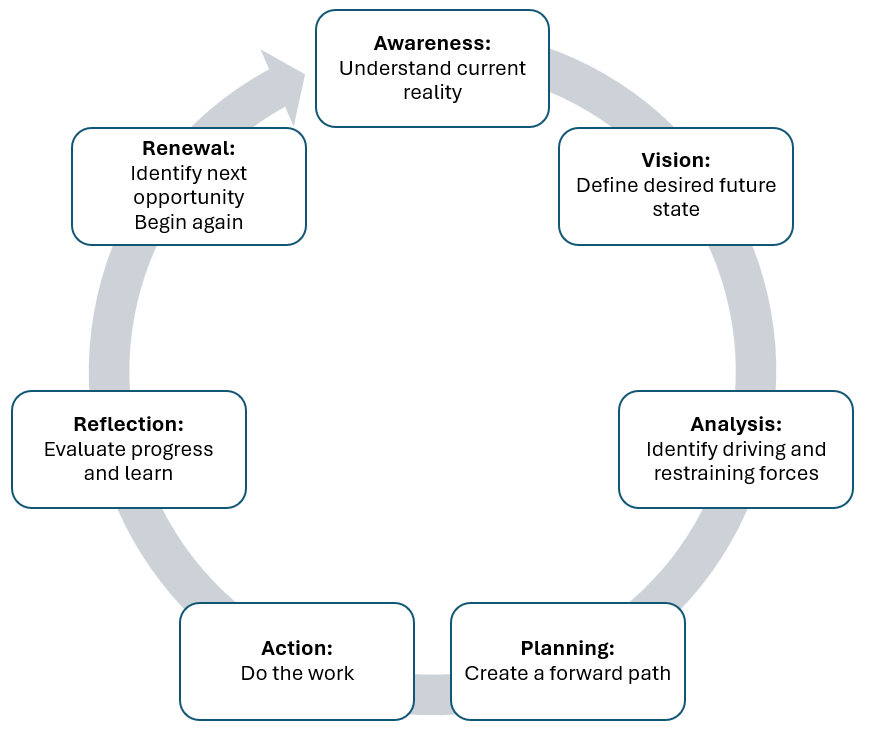
The seven stages of change and development form a continuous cycle: awareness clarifies the present, vision defines the future, analysis and planning chart the path, action builds capability, reflection turns experience into learning, and renewal begins the next cycle of growth.
Most change models ask the same basic question: How do people move from where they are to where they need to be? Lewin described behavior and performance as existing within a field of forces that either support movement or preserve the status quo [1]. Kotter emphasized urgency, vision, coalition building, and the work required to sustain change [2]. ADKAR focuses on awareness, desire, knowledge, ability, and reinforcement [3].
Each framework contributes something useful, but no single framework explains every situation. Problems arise when we become attached to one method and try to force every challenge through it. I have described this tendency as methodological myopia: the habit of viewing complex problems through one familiar lens while overlooking useful insights from other perspectives [4].
A more useful approach is synthegration [4]: bringing multiple viewpoints together so we can see the situation more clearly. When ideas from change management, psychology, education, neuroscience, leadership, and human development are considered together, a common developmental pattern begins to emerge.
For example, a struggling employee may appear to have a motivation problem. A single-lens response might be to demand more accountability. A synthegrative response asks better questions: Is the goal clear? Are key skills missing? Does the employee have enough support and feedback? Are organizational barriers getting in the way?
Those questions help reveal whether the real gap involves motivation, capability, support, or system design.
Taken together, these perspectives point to a practical developmental pattern. People first recognize where they are, clarify where they need to be, examine what helps or hinders progress, and then build capability through action, reflection, and renewal.
- Awareness develops an accurate understanding of current reality.
- Vision defines a meaningful and desirable future state.
- Analysis identifies the forces helping and hindering progress.
- Planning translates aspirations into achievable next steps.
- Action transforms knowledge into capability through experience.
- Reflection converts experience into learning.
- Renewal identifies the next opportunity for growth and begins the cycle again.
Although presented sequentially, these stages frequently overlap and influence one another. Together they provide a useful framework for understanding organizational change, professional development, personal growth, and lifelong learning.
1. Awareness: understand current reality
Every meaningful change begins with an honest assessment of the present.
Individuals and organizations must understand where they are before deciding where they want to go. Current performance, strengths, limitations, assumptions, habits, resources, opportunities, and environmental realities all matter. Without an accurate understanding of the present, the desired future becomes little more than wishful thinking.
This principle appears throughout the change literature. Lewin's work begins with understanding the current field of forces [1]. ADKAR begins with awareness [3]. Effective leaders diagnose before they prescribe.
Simply put, we cannot close a gap we cannot see.
2. Vision: define a desired future state
Once current reality is understood, attention shifts toward the future.
A meaningful vision answers several questions:
- What does success look like?
- What capabilities need to be developed?
- What outcomes matter most?
- How will progress be recognized?
A compelling vision provides direction and purpose. Kotter argued that transformational change requires a vision capable of guiding action [2]. ADKAR similarly recognizes that people are more willing to invest effort when they understand why change matters [3].
Maslow helps explain why this matters. He argued that people naturally want to grow, but growth is rarely the easy choice. Growth begins with the honest recognition that where we are is not enough for where we want to go. It means leaving what feels familiar, accepting discomfort, and doing the work required to become more capable [5]. A vision gives people a reason to make that harder choice. It turns the gap from a vague source of frustration into a clear direction for effort.
Without a desired future state, there is no meaningful gap to close and little reason to begin the journey.
3. Analysis: identify driving and restraining forces
Progress does not occur in isolation.
Every change effort exists within a system of forces that either support movement or resist it.
Examples of driving forces
- Coaching and mentoring provide guidance and feedback.
- Resources and opportunities make progress more achievable.
- Curiosity and motivation encourage continued effort.
- Supportive relationships reinforce growth and persistence.
Examples of restraining forces
- Fear and uncertainty discourage action.
- Competing priorities consume time and attention.
- Skill gaps limit performance.
- Resource constraints create barriers to progress.
Lewin described these influences as driving and restraining forces [1]. His insight remains valuable because it reminds us that progress is not always a matter of working harder. Sometimes the most effective intervention is removing barriers that consume energy and attention.
Analysis transforms aspiration into strategy by helping us understand what must be strengthened, what must be reduced, and what must be managed.
4. Planning: create a path forward
A vision without a path remains an aspiration.
Large goals often appear intimidating when viewed as a single leap. They become manageable when translated into the next milestone, the next capability, the next project, or the next action.
This principle aligns closely with educational theory. Vygotsky argued that learning occurs most effectively in the space between what an individual can already accomplish independently and what becomes possible with appropriate support and guidance [6]. He referred to this as the Zone of Proximal Development.
Effective planning focuses on several practical priorities:
- The next step rather than the entire journey.
- Challenges that stretch capability without overwhelming the learner.
- Incremental progress rather than dramatic transformation.
- Consistent movement rather than perfect performance.
Growth is neither a giant leap nor a passive process. It is a sequence of challenges that gradually expand capability while remaining achievable.
5. Action: do the work
If gap analysis identifies the journey, action is where movement begins. Planning creates structure. Motivation creates energy. Progress depends on behavior.
How capability develops
A useful way to visualize capability development is as a progression:
- Knowledge provides a foundation. We learn concepts, principles, theories, and techniques.
- Application creates experience. We begin using what we have learned in authentic situations.
- Practice builds skill. Repeated application improves consistency, confidence, and effectiveness.
- Feedback drives improvement. Successes and mistakes reveal strengths, weaknesses, and opportunities for growth.
- Experience develops judgment. Patterns become recognizable and decision-making becomes more sophisticated.
- Capability emerges through repetition. What once required conscious effort gradually becomes fluent and reliable.
The knowledge-capability gap
This distinction is easy to overlook because educational systems often reward knowledge more readily than performance. Reading a book, attending a workshop, watching a video, or earning a degree can increase knowledge. Knowledge alone, however, does not create capability.
Many people confuse learning about something with learning how to do it.
A person can understand leadership principles without becoming an effective leader. Someone can understand communication theory without becoming an effective communicator. An individual can have expert knowledge of baseball but still lack the ability to catch, throw, hit, or run. The same is true of negotiation, coaching, project management, teaching, and change leadership.
Consider SCUBA diving. A person may thoroughly understand diving physics, decompression theory, equipment systems, emergency procedures, and underwater navigation. That person may earn perfect scores on written examinations and explain every principle correctly. Yet if that same individual has never operated the gear, entered the water, maintained buoyancy, managed equipment problems, or practiced emergency procedures, knowledge alone will not ensure safe performance.
The difference between knowing and doing matters.
In organizations, the consequences are usually less dramatic than a diving emergency, but they are no less real. Strategies remain trapped in slide decks. Leadership models remain theoretical. Training programs create awareness but fail to create capability.
How learning becomes capability
Bloom's revised taxonomy helps explain why [7]. Learning develops through progressively more sophisticated levels of performance:
- Remember: Recall information, terminology, facts, and foundational concepts.
- Understand: Explain ideas, interpret meaning, and demonstrate comprehension.
- Apply: Use knowledge, methods, and concepts in practical situations.
- Analyze: Examine relationships, patterns, assumptions, and underlying causes.
- Evaluate: Compare alternatives, make judgments, and justify conclusions.
- Create: Develop original solutions, new approaches, innovations, or insights.
Bloom's model reminds us that remembering and understanding are only the beginning. Knowledge becomes increasingly valuable as learners begin applying, analyzing, evaluating, and creating. Growth accelerates when learning leaves the classroom and enters the real world.
Neuroscience reinforces the same conclusion. The adult brain remains capable of change throughout life. Experience, practice, repetition, feedback, and changing demands reshape neural systems over time [8], [9]. Skills are not downloaded. They are developed.
Action is the bridge between knowing and becoming.
6. Reflection: evaluate progress and learn
Experience becomes valuable when it is transformed into learning.
Reflection allows individuals and organizations to evaluate outcomes, identify lessons, and adjust future behavior.
Four reflection questions. These questions help turn experience into useful feedback by separating what should be reinforced from what should be adjusted.
- What worked? Identify effective practices and strengths worth repeating.
- What did not work? Recognize obstacles, errors, and ineffective approaches.
- What should be repeated? Reinforce behaviors that contributed to progress.
- What should change? Adapt strategies based on evidence and experience.
Research on expertise consistently highlights the importance of feedback and deliberate practice [10]. Improvement does not come from repetition alone. It comes from repetition combined with evaluation and adjustment.
Successes reinforce effective behaviors. Setbacks provide information. Both contribute to growth when people remain willing to learn from results.
7. Renewal: begin again
Many people think of growth as a destination. Episodic change models can reinforce that misunderstanding when they emphasize a final refreeze stage, as if the goal were simply to preserve a new status quo.
Developmental research points in a different direction.
Achieving a goal rarely marks the end of development. It often changes the context and reveals new opportunities for growth. Earning a degree can provide knowledge and skills that create new professional possibilities. A promotion introduces new leadership challenges. Mastering one capability creates opportunities to develop another. Even when people try to preserve a new status quo, the surrounding environment continues to change. The point is not to freeze development in place, but to use each achievement as the starting point for the next iteration.
When one gap closes, another becomes visible. Every ending represents a new beginning.
Dynamic Skills Theory helps explain this pattern. Development occurs through the ongoing construction, integration, and refinement of increasingly sophisticated capabilities [11].
The renewal cycle
Renewal follows a simple pattern: each achievement changes the situation, reveals new demands, and creates the next opportunity to learn and grow.
- New experiences create new demands. Success changes the environment and raises expectations.
- New demands reveal new gaps. Emerging challenges expose areas for development.
- New gaps create new learning opportunities. Growth becomes necessary to meet new expectations.
- New learning expands capability. Enhanced capability creates the foundation for future growth.
Renewal is therefore not the end of the process. It is the start of the next iteration.
Every ending is a new beginning.
Development is a web, not a ladder
One limitation of many development models is that they make growth appear linear.
Learn a skill. Master a skill. Move to the next skill. Human development is far more interconnected.
Dynamic Skills Theory suggests that development resembles a web rather than a ladder [11]. Capabilities develop together and influence one another.
Examples from the developmental web
These examples show how major capabilities rarely stand alone; each one depends on a network of related skills that develop together and strengthen one another over time.
- Leadership draws upon communication, judgment, emotional intelligence, and relationship skills.
- Communication depends on listening, clarity, perspective taking, and self-awareness.
- Listening depends on attention, empathy, patience, and self-regulation.
- Strategic thinking depends on knowledge, analytical ability, judgment, and systems awareness.
- Learning strengthens every other capability by expanding knowledge, experience, and perspective.
As these capabilities develop, they reinforce one another. Weaknesses in one area can constrain performance in others.
Development is therefore not simply the accumulation of skills. Development is the integration of skills.
![The developmental web: Skills grow and connect like branches, creating a complex network in your brain. [Fischer, 2003 & 2009]](/images/developmental-web600.jpg "The developmental web: Skills grow and connect like branches, creating a complex network in your brain. [Fischer, 2003 & 2009]")
From struggle to virtuosity
One of the most important lessons from developmental theory is that struggle is not evidence of failure; it is essential for growth.
New capabilities rarely emerge fully formed. Early performance is typically slow, effortful, and inconsistent because learners are building skills that do not yet exist.
The developmental progression
This progression shows how early struggle gradually becomes capability as learners move from first exposure to practiced, integrated, and eventually fluid performance.
- Exposure creates awareness. We encounter new ideas, challenge, or skill and recognize what we do not yet know.
- Practice creates familiarity. Repeated attempts reduce uncertainty and increase comfort.
- Repetition creates competence. Performance becomes more consistent and reliable.
- Integration creates proficiency. Individual skills begin working together as part of a larger system.
- Refinement creates expertise. Judgment, efficiency, and adaptability improve through experience and feedback.
- Sustained expertise produces virtuosity. High levels of performance become flexible, fluid, and transferable across contexts.
Anyone who has learned music understands this progression. A single note becomes a scale. A scale becomes a melody. A melody becomes a song.
Leadership develops in much the same way. Communication skills become relationship skills. Relationship skills become influence. Influence becomes leadership capability.
Virtuosity is not the absence of struggle. It is the result of successfully navigating countless cycles of effort, feedback, adjustment, and improvement.
What the research converges on
Neuroscience, motivational psychology, educational theory, and expertise research approach development from different directions. Yet they converge on a common conclusion: meaningful growth is possible throughout life, but it is not automatic. Human beings may have a natural orientation toward growth, development, and self-actualization, but they also face the pull of safety, comfort, and familiar routines [5].
Shared conclusions across disciplines include the following:
- The adult brain changes through experience and effort. Practice, feedback, repetition, and changing demands continue shaping neural pathways throughout life, but those changes require engagement rather than passive exposure [8], [9].
- Motivation sustains persistence. People are more likely to continue difficult work when they experience competence, autonomy, and connection to meaningful goals [12]. Maslow's growth-motivation perspective adds that people are drawn toward self-actualization, but growth often requires moving beyond safety, comfort, and familiarity [5].
- Learning thrives in the stretch zone. Growth occurs when challenges exceed current capability but remain achievable with support, guidance, and continued effort [6].
- Expertise develops through deliberate practice. High performance emerges from focused effort, feedback, correction, and persistence over time rather than isolated insights or talent alone [10].
- Capability requires hard work over time. Development depends on repeated attempts, reflection, adjustment, and the willingness to keep working when progress feels slow. Gap analysis reveals the growth opportunity; effort and persistence are what close it [10], [13], [5].
The details differ across disciplines, but the shared message is clear: growth is not merely a matter of exposure, intention, or talent. It requires sustained effort directed toward meaningful challenges. Further, it often requires choosing development over the comfort of remaining where we are.
Put simply, research points to four practical takeaways:
- Growth is a process. Development unfolds through repeated cycles of awareness, effort, feedback, and renewal.
- Capability is constructed. People become capable by applying knowledge, practicing skills, and integrating experience over time.
- Development takes time. Meaningful change rarely happens all at once; it grows through steady progress and adjustment.
- Learning requires effort and persistence. Recognizing the gap matters, but growth happens when people keep working to close it.
What's next?
One of the most persistent misconceptions about success is that accomplished people eventually arrive.
They do not. They become better at recognizing the next gap.
A degree does not mean learning is finished. Its value comes from the knowledge, skills, and growth it represents. A promotion does not mean development is complete. Reaching a goal does not mean growth is over.
Each accomplishment creates new possibilities, new responsibilities, and new challenges.
Human development is less dramatic than gaining superpowers from a radioactive spider or instantly downloading expertise like a character in The Matrix. It is also far more encouraging. Extraordinary capability usually grows from something much more ordinary: recognizing the gap between where we are and where we need to be, then doing the work required to close it.
The pattern to remember
This sequence offers a practical way to recognize a gap, close it through effort, and begin again when new growth becomes possible.
Awareness → Vision → Analysis → Planning → Action → Reflection → Renewal →
- Know where you are. Assess current reality honestly.
- Know where you want to go. Define a meaningful future state.
- Understand the forces involved. Identify barriers and sources of support.
- Create a realistic path forward. Break the journey into achievable steps.
- Do the work. Transform knowledge into capability through action.
- Learn from the results. Use feedback to improve performance.
- Begin again. Recognize the next opportunity for growth.
Lifelong learning, leadership development, personal growth, and professional excellence all emerge from the same process: recognizing gaps, choosing growth over familiarity, building capability through sustained effort, integrating new skills into a broader developmental web, and identifying the next opportunity for growth.
The challenge is not to eliminate every gap. The challenge is to identify the next meaningful gap and take the next meaningful step. And when that gap begins to close, ask the question that drives all development:
- What's next?
Notes on sources
The seven-stage pattern described in this article is a teaching synthesis rather than a model proposed by any single author. It also reflects the synthegrative approach described through Synthegrate: integrating multiple viewpoints to better understand complex learning, development, and change processes. Lewin, Kotter, Hiatt, Maslow, Vygotsky, Anderson and Krathwohl, Kolb and Gibb, Lövdén and colleagues, Ericsson and colleagues, Fischer and Bidell, Ryan and Deci, and Duckworth and colleagues each contribute part of the explanation. The value of the framework lies in bringing these perspectives together to better understand how people learn, develop capability, sustain effort, choose growth, and navigate change throughout their lives.
References
[1] K. Lewin, Field Theory in Social Science: Selected Theoretical Papers. New York, NY, USA: Harper & Row, 1951.
[2] J. P. Kotter, Leading Change. Boston, MA, USA: Harvard Business School Press, 1996.
[3] J. M. Hiatt, ADKAR: A Model for Change in Business, Government and Our Community. Loveland, CO, USA: Prosci, 2006.
[4] B. Duncan, "Human Synthesis and Learning Perspectives," Synthegrate. Available: https://synthegrate.com/
[5] A. H. Maslow, Toward a Psychology of Being, 2nd ed. Princeton, NJ, USA: Van Nostrand, 1968.
[6] L. S. Vygotsky, Mind in Society: The Development of Higher Psychological Processes. Cambridge, MA, USA: Harvard University Press, 1978.
[7] L. W. Anderson and D. R. Krathwohl, Eds., A Taxonomy for Learning, Teaching, and Assessing: A Revision of Bloom's Taxonomy of Educational Objectives. New York, NY, USA: Longman, 2001.
[8] B. Kolb and R. Gibb, "Brain plasticity and behaviour in the developing brain," Journal of the Canadian Academy of Child and Adolescent Psychiatry, vol. 20, no. 4, pp. 265-276, 2011.
[9] M. Lövdén, E. Wenger, J. Mårtensson, U. Lindenberger, and L. Bäckman, "Structural brain plasticity in adult learning and development," Neuroscience & Biobehavioral Reviews, vol. 37, no. 9, pt. B, pp. 2296-2310, 2013.
[10] K. A. Ericsson, R. T. Krampe, and C. Tesch-Römer, "The role of deliberate practice in the acquisition of expert performance," Psychological Review, vol. 100, no. 3, pp. 363-406, 1993.
[11] K. W. Fischer and T. R. Bidell, "Dynamic development of action and thought," in Handbook of Child Psychology: Theoretical Models of Human Development, 6th ed., R. M. Lerner and W. Damon, Eds. Hoboken, NJ, USA: Wiley, 2006, pp. 313-399.
[12] R. M. Ryan and E. L. Deci, Self-Determination Theory: Basic Psychological Needs in Motivation, Development, and Wellness. New York, NY, USA: Guilford Press, 2017.
[13] A. L. Duckworth, C. Peterson, M. D. Matthews, and D. R. Kelly, "Grit: Perseverance and passion for long-term goals," Journal of Personality and Social Psychology, vol. 92, no. 6, pp. 1087-1101, 2007.