Gagliardi’s three types of cultural change
Focusing on the relationship between strategy and culture, Gagliardi (1986 in Hatch, 2004) built on Shein’s Assumptions > Values > Artifacts model to propose a theory that shows stability and change as opposing forces with three outcomes: apparent change, incremental change, and revolutionary change.
Apparent change
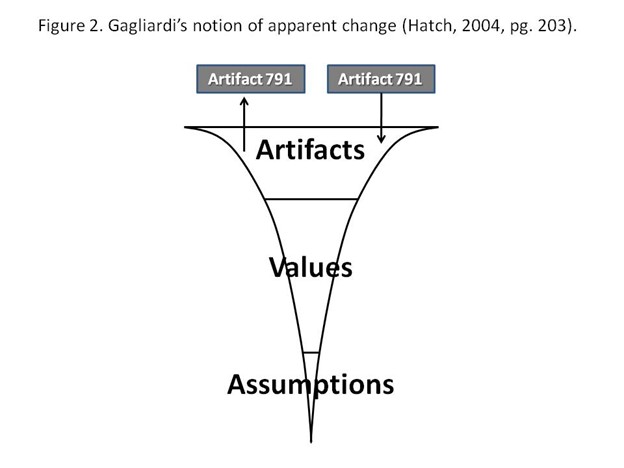
Apparent change [Figure 2] happens inside a culture but does not change the fundamental nature of the culture. Apparent change is an example of how cultures change while staying the same, like when interventions realign activities around the existing assumptions and values, changing only the cultural artifacts.
Incremental change
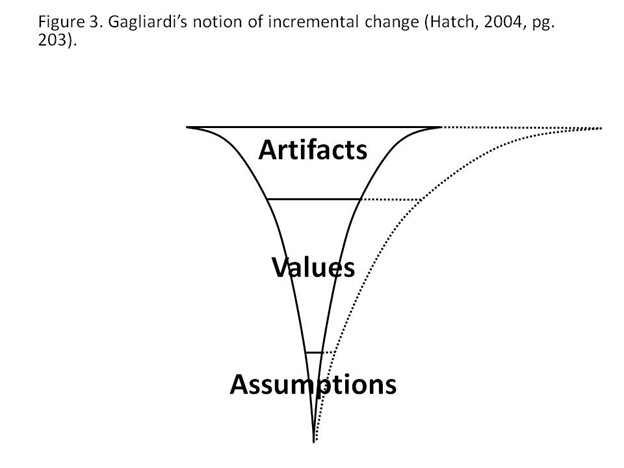
Incremental change [Figure 3] introduces new compatible values that exist with the old values. Implementing different strategies that remain compatible with existing assumptions and values can expand the culture.
This concept is similar to Koreber’s (1944 in Hatch, 2004) cultural growth concept in that the existing cultural patterns reinforce the growing patterns, allowing them to cumulatively develop. This suggests that successful incremental strategies require a process that resonates with the web of cultural meaning rather than just understanding the compatibility of assumptions and values.
Revolutionary change
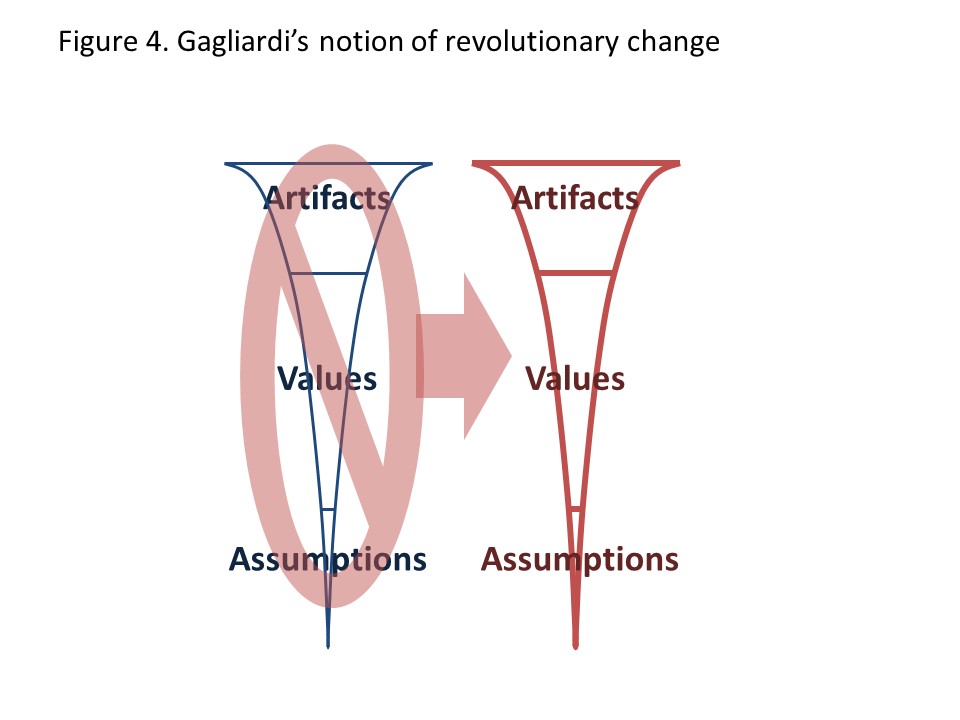
Revolutionary change [Figure 4] imposes a strategy that is incompatible with key assumptions and values using outsiders who destroy old symbols while they create new ones. Examples include bringing in a new chief executive officer from outside the organization, merging two organizations, and downsizing an organization. Strategies that conflict with assumptions and values destroy the existing culture or resist. More accurately, the old firm dies, and a new firm is born. Culture is replaced, not changed. Kroeber had proposed a similar model through which he viewed revolt against cultural patterns, a concept he called pattern rupture.
Arguing that concepts like harmony and symmetry can become mechanical and dull, Kroeberg (1944 in Hatch, 2004) proposed that revolt “is not necessarily the worst course” (765). Innovation comes from breaking patterns, not from preserving them. This may glorify revolution, but it does provide a point for organizational writers to consider. Outdated operational modes can threaten the viability of organizations, like when Western economies exhausted domestic manufacturing as an economic pattern. In such cases, economic viability may justify the destruction of cultures built on outdated patterns. Recent experiences confirm that cultural renewal can follow cultural destruction.