


The dynamically developing adult brain
A recent update of dynamic skills theory illuminates the workings of the adult brain, providing insights and suggesting tools for supporting adult learning. Fischer (2007) has integrated his dynamic skills theory with emerging cognitive neuroscience and dynamic systems theory to propose a dynamic skills framework that shows how "thinking and learning relate to physical changes in the brain" (Fischer & Rose, Growth cycles of brain and mind, 1998, p. 56) and that provides a toolkit for showing how development, context, learning, and emotion intertwine to change behavior (2007).
Dynamic skills theory rejects traditional theories that separate logic from emotion and organism from the environment, asserting that these traditionally dichotomous categories collaborate to produce human thought and behavior. Dynamic skills theory also rejects classical stage views of development because they lump people into rigid categories that do not account for human behavior's complex and diverse nature. As described by Fischer and Rose (1998): "In the dynamic skills framework, development is much more variable and flexible and shows complex, dynamic patterns of change with many of the properties described by mathematical theories of complexity, chaos, and catastrophe" (p. 56).
Interacting cycles of brain growth
Rather than developing in a linear or stepped path, Fischer demonstrates how individuals exhibit complex developmental patterns with interacting cycles of brain growth, cognitive development, and learning. Fischer asserts that "all three cycles seem to involve a common process of growth, and one outcome of the research on these growth patterns is the discovery of a general ruler for development and learning that has many uses in educational assessment and practice" (2007, p. 2).
These growth cycles repeat several times, with each cycle presenting a "new capacity for thinking and learning that appears to be grounded in an expanded, reorganized neural network". This means that people can learn and relearn skills and reshape their brains throughout life—especially if they have "strong contextual support, like that from a teacher, a tutor, or a text. Without such support, most thinking and learning occur at lower levels, not at optimal levels" (1998, p. 56).

Developmental web
Fischer uses a developmental web as a metaphor to show how development occurs on multiple parallel strands rather than through linear stages. Using multiple intelligence theory as an example, a child develops different intellectual domains for language, logic and math, music, physical coordination, pattern recognition, interpersonal relations, and intra-personal relations (Gardner, 2006). Within each of these domains, the individual constructs new skills, with each new skill represented by a new strand. Each new skill branches to form an increasingly complex skill set that may branch and connect with other strands to form an increasingly complex developmental web (Fischer K. W., 2007).

Brain integration goes beyond maturity to wisdom
The cyclical development demonstrated by Fischer continues into the mid-twenties, when the frontal lobe becomes fully developed, hard-wiring the individual for maturity. However, this is not the end of brain development. In addition to remaining pliable throughout life, Cohen (2006) points to research showing that at least one primary developmental phase occurs in the mid-forties when the left and right hemispheres become more fully integrated.
The increased network connections and the flow of information between the right and left hemispheres create the capacity for greater creativity while dampening negative emotions. While the individual becomes hardwired for maturity in the mid-twenties, the individual seems to become hardwired for wisdom in the mid-forties.
Rewiring the brain throughout life
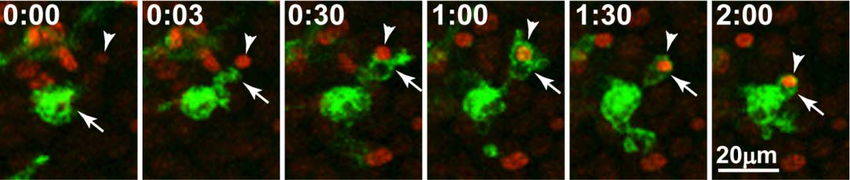
Beyond this developmental cycle, the adult brain continues to rewire itself, grow new cells, and create new connections. Showing full-color images of thousands of neurons born each day in transgenic mice, Harvard Medical provides graphical images of how behavior and environment may influence brain development (Livet, et al., 2007). While the researchers remain unclear about how the new cells connect with the old, they believe that tracing connections may help understand how experience gets transferred from short-term to permanent memory and how memory-stealing diseases advance.
![Brainbow images of mice show how the brain continues to rewire itself, grow new cells, and create new connections throughout life. [Harvard Medical]](/images/brainbow.jpg "Brainbow images of mice show how the brain continues to rewire itself, grow new cells, and create new connections throughout life. [Harvard Medical]")
The moldable brain
Additional research showing the dynamically developing adult brain comes from Johns Hopkins Medicine (2008) research, which demonstrates how mature neurons retain a youthful form of plasticity called motility. The firm trunk of a neuron grows upwards but extends branches and axons, which spread sideways into the cerebellum and help coordinate movements and sensory information. Rather than being fixed, these branches sway “like kite tails in the wind” while growing and shrinking. The researchers believe the motility of neurons provides a secondary mechanism for conveying information beyond traditional synapses and may assist in nerve regeneration.



![Your brain can keep growing, adapting, and learning at any age, if you are willing to put in the effort [Image: Copilot]](/images/Images/best-years-for-adult-brain300.png)